
Oracle Database Appliance (ODA): Architecture, Components and Benefits
Managing enterprise database infrastructure can be complicated. Organizations often need to integrate servers, storage, networking, operating systems and database software while ensuring performance, availability and security.
Oracle Database Appliance (ODA) simplifies this process by providing an integrated hardware and software platform specifically designed for Oracle Database workloads. Instead of building and configuring every infrastructure component separately, businesses can deploy a pre-engineered system with Oracle software and management tools.
In this guide, we explore Oracle Database Appliance, its architecture, hardware and software components, deployment options, management tools, licensing and business benefits.
1. What Is Oracle Database Appliance (ODA)?
Oracle Database Appliance is an Oracle Engineered System that combines servers, storage, networking and software into an integrated platform optimized for Oracle Database.
It is designed to simplify database deployment, maintenance, patching and support. ODA supports Oracle Database Standard Edition and Enterprise Edition, subject to the supported hardware, software and licensing requirements.
Businesses can use ODA to run:
- Enterprise database applications
- Transaction processing workloads (OLTP)
- Business intelligence and reporting systems
- Departmental databases
- Consolidated database environments
- Application and database workloads
Unlike traditional infrastructure deployments, where organizations must independently select, integrate and validate multiple hardware and software components, ODA provides a pre-engineered platform with integrated management capabilities.
2. Oracle Database Appliance Architecture
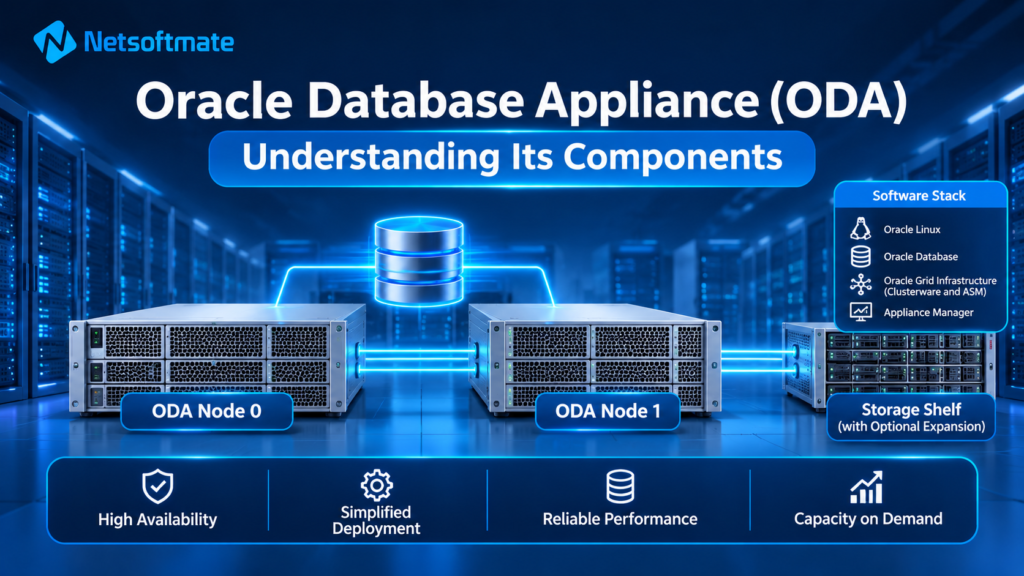
ODA combines computing, storage, networking and database software into a single engineered solution.
Its architecture varies according to the hardware model and deployment configuration. Modern ODA models are available in single-node and high-availability configurations.
The major architectural components include:
Compute servers: Provide the processing power and memory required to run Oracle Database and associated applications.
Storage infrastructure: Provides storage for operating systems, database files and other system data. Storage configurations vary by ODA model.
Network connectivity: Connects database servers, storage components, applications and external networks.
Oracle Linux: Provides the operating system foundation for the appliance.
Oracle Grid Infrastructure: Provides cluster management and related high-availability capabilities where supported by the deployment.
Oracle Database: Runs business applications and manages enterprise data.
The hardware and software are engineered to work together, reducing the integration effort associated with building a database platform from separate components.
3. Hardware Components of Oracle Database Appliance
The hardware configuration depends on the selected ODA model. Current generations include the X11 and X10 families, with different configurations for smaller deployments, larger databases and high availability.
The primary hardware components include:
A. Compute Servers
Compute servers execute database operations, application workloads and system processes.
ODA models are available in different configurations:
- X11-S: A single-server configuration designed for smaller or entry-level deployments.
- X11-L: A single-server configuration designed for larger database workloads.
- X11-HA: A two-server configuration designed for larger databases and high availability.
The X10 family also includes S, L and HA configurations.
B. Storage
Storage provides capacity for database files, application data and system operations.
Depending on the model, ODA can include internal NVMe storage and dedicated storage shelves containing SSDs or supported HDD configurations.
Storage capacity and expansion options differ between models, so organizations should evaluate performance and capacity requirements before selecting an appliance.
C. Networking and Interconnect
Networking connects the appliance to application servers, users and external infrastructure.
High-availability models also include dedicated node-to-node connectivity to support communication between the two server nodes.
D. Power and Cooling
Redundant power supplies and cooling components help maintain hardware operation and reduce the impact of individual component failures.
The exact hardware specifications depend on the appliance generation and configuration.
4. Software Components of Oracle Database Appliance
ODA integrates several software components that work together to provide database services and appliance management.
Software component | Purpose |
Oracle Linux | Operating system for the appliance |
Oracle Database | Stores and manages enterprise data |
Oracle Grid Infrastructure | Provides cluster management and related availability capabilities |
Oracle Automatic Storage Management (ASM) | Manages database storage |
Oracle Appliance Manager | Provides appliance deployment and management capabilities |
Oracle Integrated Lights Out Manager (ILOM) | Supports remote hardware management |
Oracle Appliance Manager CLI | Provides command-line administration |
The installed software versions and available capabilities depend on the hardware model and supported ODA release.
5. Oracle Database Appliance Deployment Options
ODA supports different deployment approaches depending on the appliance generation and software configuration.
A. Bare Metal Deployment
In a bare metal deployment, Oracle Database and the associated infrastructure software run directly on the appliance’s operating system environment.
This approach provides a dedicated database platform without requiring a separate virtualized environment for the database deployment.
It is suitable for organizations that primarily want to run Oracle Database workloads on the appliance.
B. Virtualized Deployment
Supported ODA configurations also provide virtualization capabilities.
Organizations can run supported application workloads in virtual machines while maintaining database workloads on the appliance.
Newer ODA releases use KVM-based virtualization for supported deployments. Older virtualized platforms may use Oracle VM (Xen).
The available virtualization options depend on the hardware model and software release. Therefore, organizations should verify the supported deployment architecture before implementation.
6. Managing Oracle Database Appliance: ODACLI, ODAADMCLI and OAKCLI
Oracle provides management tools to simplify appliance administration, deployment and maintenance.
Understanding the difference between these utilities is important for database administrators.
ODACLI (Oracle Database Appliance Command-Line Interface)
ODACLI is used for most appliance lifecycle management activities, including:
- Appliance deployment and configuration
- Database creation and management
- Database Home management
- Network configuration
- Database system management
- Patching and lifecycle operations
ODAADMCLI
ODAADMCLI is primarily used for hardware administration and monitoring, including storage, disks, controllers, processors, memory and other hardware components.
OAKCLI
OAKCLI is the older Oracle Appliance Manager command-line interface associated with legacy ODA environments and Oracle VM-based virtualized deployments.
Oracle deprecated OAKCLI for bare metal deployments beginning with ODA release 19.10. It remains relevant for supported legacy Oracle VM deployments.
For newer bare metal systems, administrators generally use ODACLI and ODAADMCLI rather than OAKCLI.
7. Oracle Database Appliance Licensing
One of ODA’s important features is its capacity-on-demand licensing capability.
Capacity-on-demand allows supported appliance configurations to operate with a selected number of active CPU cores. Organizations can initially enable fewer cores and increase capacity when additional processing power is required.
This can help manage Oracle Database Enterprise Edition licensing costs.
However, organizations should understand that:
- Oracle Database software licensing is separate from the appliance hardware purchase.
- Licensing requirements depend on the database edition, deployment model and active CPU configuration.
- Capacity-on-demand rules differ according to the hardware generation.
- Virtualization and hard-partitioning requirements must be reviewed carefully.
Businesses should consult Oracle’s licensing documentation before finalizing their appliance configuration. Hardware capacity and database licensing should be evaluated together.
8. Benefits of Oracle Database Appliance
ODA offers several advantages for organizations running Oracle Database workloads.
Simplified deployment: Pre-engineered hardware and software reduce the effort required to integrate separate infrastructure components.
High availability: Supported HA configurations provide two-node infrastructure designed to improve database service availability.
Integrated management: Oracle Appliance Manager provides tools for deployment, monitoring, database administration and patching.
Reduced integration complexity: Hardware and software are designed to work together, reducing the need for extensive infrastructure validation.
Flexible capacity: Supported capacity-on-demand licensing allows organizations to manage active CPU cores according to their requirements.
Simplified support: An integrated Oracle platform can simplify infrastructure troubleshooting and support coordination.
9. Oracle Database Appliance vs Oracle Exadata
ODA and Exadata are both Oracle Engineered Systems, but they are designed for different infrastructure requirements.
Comparison | Oracle Database Appliance | Oracle Exadata |
Primary focus | Simplified Oracle Database deployment | High-performance enterprise database infrastructure |
Architecture | Integrated database appliance | Scale-out database and intelligent storage architecture |
Deployment | Available in single-node and HA configurations | Available in different on-premises and cloud deployment models |
Scalability | Depends on the selected ODA model | Designed for larger scale-out configurations |
Workloads | Departmental and enterprise database workloads | Demanding OLTP, analytics and mixed workloads |
Typical selection | Organizations seeking simplified database infrastructure | Organizations requiring advanced performance and scalability |
The right choice depends on database size, workload characteristics, availability requirements, scalability and budget.
ODA is not simply a smaller version of Exadata. Each platform has a different architecture and intended deployment profile.
10. When Should Businesses Consider Oracle Database Appliance?
ODA can be suitable for organizations that want a dedicated Oracle Database platform without managing the complexity of assembling infrastructure components independently.
Common use cases include:
- Running ERP and enterprise business applications.
- Consolidating multiple Oracle databases.
- Supporting transaction processing workloads.
- Deploying departmental database environments.
- Improving database infrastructure availability.
- Simplifying database deployment and maintenance.
Before purchasing an appliance, businesses should evaluate database capacity, expected growth, licensing, storage requirements, recovery objectives and application compatibility.
Conclusion
Oracle Database Appliance provides an integrated platform for organizations that depend on Oracle Database. By combining compute, storage, networking and database software, it simplifies infrastructure deployment and ongoing management.
Its different hardware configurations, deployment options and capacity-on-demand capabilities make it suitable for a range of database environments.
Choosing the right ODA model requires careful evaluation of workload requirements, database licensing, performance expectations and availability objectives. With proper planning and administration, organizations can use ODA to build a reliable and manageable Oracle Database infrastructure.